'Dark Secrets of the Nativity' by Pete GreigPete Greig - 15 Dec 2014
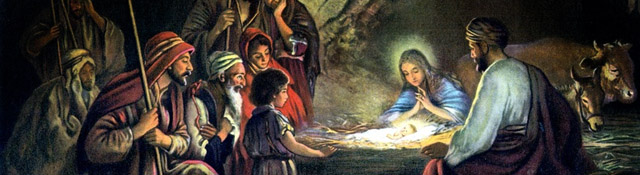
Five surprising secrets about the Christmas story that no-one ever told me before…
Secret #1: While shepherds watched
When pilgrims traveled to Jerusalem to make their sacrifices at the temple they didn’t just bring any old lamb from home. They purchased one in the city itself, one that had been specially raised for the purpose. And recent archaeological digs have revealed that most of these unfortunate lambs were farmed in one particular location just five miles due south of Jerusalem. A little place called… Bethlehem.
If this is true, it means that the very first people on earth to worship Jesus probably had the job of tending the sacrificial lambs for the temple. Think about that! The shepherds knew better than anyone else that it was the blood of Bethlehem lambs that washed away the sins of the people in Jerusalem. Day and night they watched their flocks, constantly reminded that each male lamb had been born to die for the sins of the world.
Secret #2: Hark the herald angels…
This also helps explain the angelic visitation. The heavenly host chose to appear to the shepherds for a very good reason. It wasn’t primarily (as is sometimes preached) a proletarian statement from the Godhead. Nor was it merely that the shepherds happened to be in the area (the inn next door was much closer and we know that it was full of people who would spread the word far more effectively than those lonely shepherds) No, the angels deliberately chose the shepherds as a powerful prophetic symbol: their presence at the birth was a sign for Mary and Joseph who would have to raise their own unblemished lamb to die, it was a sign for the Jerusalem temple that God’s perfect lamb had been born in Bethlehem, and ultimately it remains a sign for the whole world.
Secret #3: O, little town of Bethlehem
The precise location of the nativity is unknown but there is some conjecture, based on Micah 4:8, that the stable was situated near Migdal Edar which means ‘tower of the flock’. If so, this is remarkable because Migdal Edar was where Jacob’s wife Rachel had died, giving birth to Benjamin (Gen 35:19). Mary must surely have banished Rachel’s story from her mind, as she gave birth to Jesus on the same spot. Once again the prophetic symmetry is breathtaking: Rachel giving birth to the last of the twelve tribes and then Mary, in the same place, giving birth to the first son of the new Israel.
The great Jewish-Christian scholar Alfred Edersheim confirms the significance of this location in the second volume of his Life and Times of Jesus the Messiah. He argues that Migdal Edar was situated particularly close to the town of Bethlehem, on the road towards Jerusalem, and for that reason ‘the flocks that pastured there were destined for Temple sacrifices.’
The symmetry between Rachel and Mary goes deeper still: Rachel's name literally meant 'little lamb' and she had died in this place where sacrificial lambs would one day be born. Meanwhile Mary, whose name probably means 'beloved' survives giving birth to a little lamb whose name means 'Yahweh Saves'. And what of Benjamin's older brother, Rachel's other son? Of course he was called Joseph - a familiar name in the nativity story too! That first Joseph was betrayed and exiled to Egypt where he would eventually, through his apparent death and forgiveness, save his younger brother Benjamin, his ten older half-brothers and ultimately the whole Jewish people. Meanwhile Joseph, Mary's husband, is commanded to escape to... Egypt (where else?) in order to save the first born brother of the new Israel from King Herod's genocide.
Secret #4: Away in a Manger
The Greek word translated ‘manger’ may literally describe a ‘stall’ for keeping livestock (in Luke 13:15 that’s how it is translated). It is therefore entirely possible that the baby Jesus was put to sleep in a stall designed to accommodate livestock, and not necessarily in the rustic feeding trough that we tend to imagine lined with glowing hay. And since sheep were such a backbone of Bethlehem’s economy, it is quite possible that he was laid to rest in a stall usually reserved for the birthing of sacrificial lambs.
Secret #5: God of God, Light of Light
Pointing out the morbid significance of Bethlehem as a place that bred sacrificial lambs, and of those shepherds as the ones who oversaw the process, and of that tower as a place where Rachel had died giving birth, and of that stall as a disturbing place to lay a human baby probably wont get me invited to many Christmas parties this year. But for many people this is not a happy or an easy time of year and we banish the darkness from the story at their peril.
In his poem Journey of the Magi T.S. Eliot describes one of the Magi – presumably the one who’d brought burial spices for the baby - reflecting on the nativity and its peculiar dark conflation of birth with death:
'There was a Birth, certainly
We had evidence and no doubt. I had seen birth and death,
But had thought they were different’
In every hidden detail, the circumstances of Jesus’ birth anticipate his death. But like a painting by Rembrandt, the shadows of the nativity story make its colours shine the brighter. Unlike Rachel, Mary does not die. King Herod fails to kill Jesus. In the end, as at the beginning, life triumphs over death.
But what is the good news of Christmas for those suffering now? For Syrian refugees and persecuted Christians in Asia and the elderly unable to heat their own homes?
It is that God sees our darkness, he acknowledges, experiences and even inhabits it for, ‘The light shines in the darkness, and the darkness has not overcome it.’ (Jn 1)
‘In thy dark streets shineth
The everlasting light;
The hopes and fears of all the years
Are met in thee tonight’
All images are used by permission in accordance with commons copyright license terms:
Feature image is a derivative of the image 'Shephers 25' by Waiting for the Word.
Pete is a best-selling author, pastor and bewildered instigator of the 24-7 Prayer movement which has reached more than half the nations on earth. He is also the Senior Pastor of Emmaus Rd, Guildford, England, an Ambassador for the NGO Tearfund, and teaches at St Mellitus Theological College in London. For 7 years Pete served with the senior leadership team at HTB and Alpha International. Pete's publications include 'Red Moon Rising', 'God on Mute', ‘The Prayer Course’, and 'Dirty Glory'. He loves art galleries, live music and knocking down walls.
Pete tweets regularly @petegreig
Meet Pete