Syria: Salah's story - What the threat of a lost generation means to his six childrenJustin Byworth - 14 Mar 2014
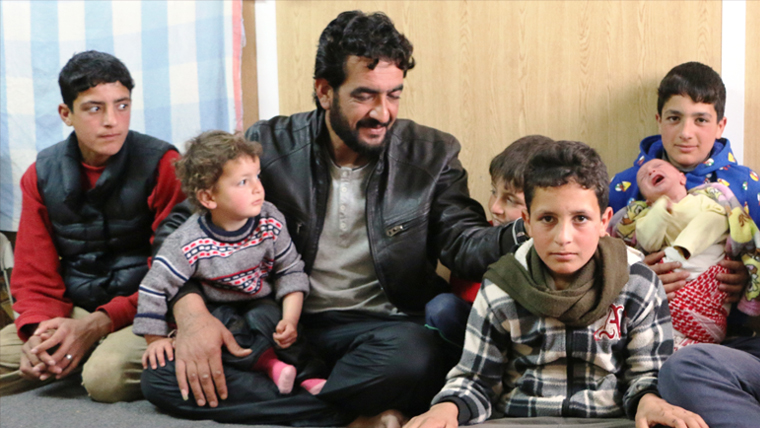
For Isaa, the crisis in Syria means a life scarred. For Alaa, it means a future stolen. Isaa and Alaa, now living in Jordan’s Zaatari refugee camp, are just two of more than 7 million Syrian children who are fast becoming a lost generation as the conflict in their country enters its fourth year. There’s close to 50,000 Syrian children in that camp alone.
Isaa had a gun put to his head by armed men who forced their way into his home when he was just 10. His older brother Habib told us:
“I was so afraid. I thought we were going to die. They came into our home, they went through all our things and asked if we had any food. My grandmother was making bread for our neighbours and they took it from us.”
Isaa’s father Salah describes with horror the tipping point that forced him, his wife and their six sons to flee their home:
“They killed our neighbour’s son. He was only 10 or so. They cut him up right in front of his father and then they took out his father’s eyes, before they killed him too. He was disabled, he only had one leg. There is no humanity.”
Alaa’s case is a stark reflection of the interruption of many young people’s futures. “I had top grades - I wanted to study communications at university. I was in my last two years of school [when the conflict broke out], but now I have no chance to finish my education,” he told us. “To get registered in school here, they told me I must bring my school papers from Syria. How is this possible when my school and house were completely destroyed? I told them I could sit an exam to show them, but they said they have too many students already. I’ve tried to study by myself at home, but I have no access to books; I can’t learn anything. I had such hopes for a good future, but now they’ve been destroyed.”
Syria’s children need protection from violence and its long-term effects. They need psychological care and support to recover from traumatic experiences such as these. They need to be able to re-start and complete their education. This is what the multi-agency No Lost Generation initiative is about. World Vision is working with Unicef, other international agencies and local communities in places where Syrian refugees have fled to in Jordan and Lebanon, to bring children like Isaa and Alaa the protection and continuity of education they deserve.
World Vision has set up child-friendly spaces in Jordan and Lebanon – staffed by our trained counsellors and containing play and educational materials – where children and young people can come to feel safer, away from violence, and have some semblance of normality. Our organisation is also providing interim and supplementary education programmes for children and has begun to set up youth centres. The transformative potential of these initiatives is evident in the infectious energy of 40 teenage girls gathered at the youth centre World Vision supports in Zarqa, a run down and remote Jordanian town where many Syrian refugee families have settled alongside an existing refugee population from other places such as Palestine. Girls from Homs, Damascus and Deraa are engaged in an animated game with their teacher, speaking confidently of their priorities and potential.
“We want educational courses,” says Asmaa, 17. Asmaa endured the horror of seeing her father shot in the kneecaps, and now doesn’t know where he is. After more than two years out of school, she may have seen her last days of formal education. “We want to study, but we can’t get registered at a school, so we love coming to the youth centre – we can’t wait until the next day,” says 14 year-old Fatima.
These child-friendly and adolescent-friendly spaces help children and young people normalise amid the brutality of war and the emotional effects of being displaced from their home and country. Khouzama, a teacher at a centre in Lebanon’s Bekaa Valley, told me in September 2013 about one particular five-year old girl who was so traumatised from seeing one of her family killed that she could no longer even speak. After a few weeks in a World Vision child-friendly space, Khouzama says, “she started to talk - and even smile again.”
Even amid the bleak, dusty, fragile life in their new countries, Syrian children hold on to hope. Asmaa, Fatima and 40 of their friends sing:
“our home is heaven, even though we have been through the fire of hell, our home is heaven and we will return”.
My hope and prayer is that the world is listening to their voices and that it will respond. Each of us can take simple actions to help protect and educate the children of Syria. World Vision continues to call on the politicians and leaders in Syria and internationally to bring an end to these long years of suffering and the risk of a lost generation of Syrian children.
How you can stand #Withsyria and the #ChildrenofSyria:
- Hold a prayer vigil between 10-16 March with your church, small group or on your own. Find resources on the World Vision website.
- Sign the petition calling for the end of suffering for the #ChildrenofSyria.
- Donate to World Vision’s Syria Appeal.